

Pantothenate kinase-associated neurodegeneration (PKAN), historically also known as Hallervorden-Spatz syndrome, is an autosomal recessive disorder causing involuntary spasticity and progressive dementia. It is a subset of neurodegeneration with brain iron accumulation (NBIA).
On this page:
Epidemiology
Classical PKAN tends to have onset before 6 years of age, whereas atypical PKAN manifests at a mean age of 14 years 10. Prevalence is estimated around 1-3 per million 10.
Clinical presentation
Described features include 9,11:
progressive dementia
extrapyramidal signs (rigidity, dystonia, choreoathetosis)
corticospinal signs (spasticity, hyperreflexia)
dysarthria
tremors
The clinical course is usually relentlessly progressive with affected individuals dying in their second or third decade.
The diagnosis is made by a combination of clinical and imaging features, however, genetic testing and full gene sequencing of the PANK2 gene to identify biallelic PANK2 pathogenic variants is considered the gold standard 14.
Radiographic features
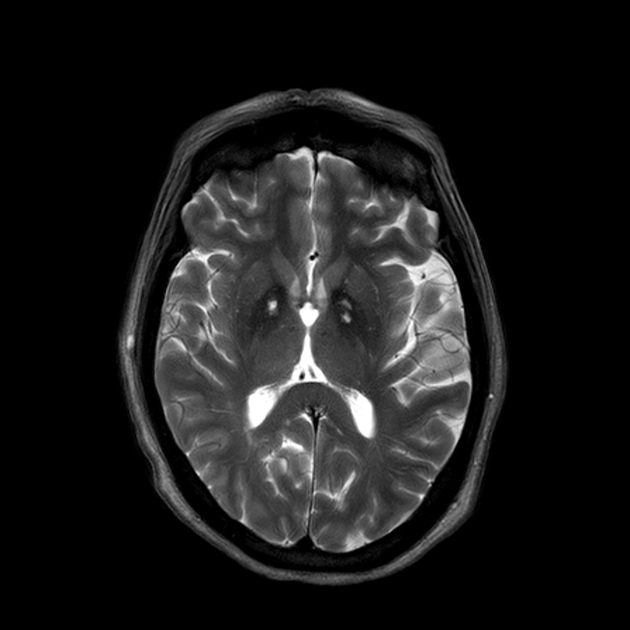
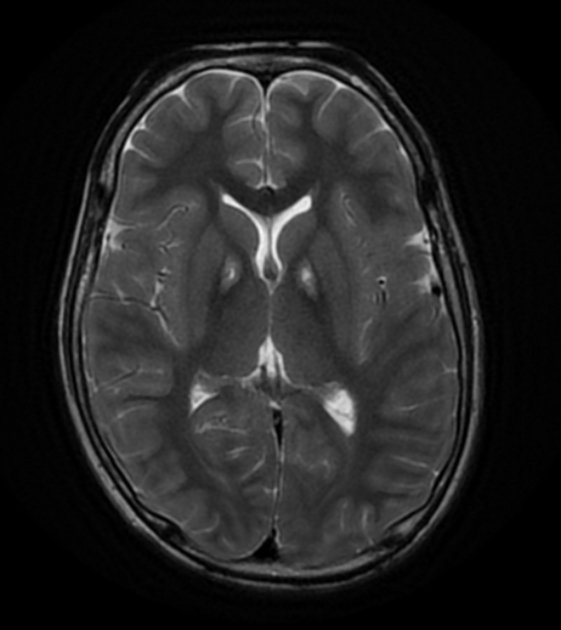
Reflects areas of iron deposition, mainly in the globi pallidi, substantia nigra, and red nuclei.
CT
CT is of limited utility but often shows calcification of the globi pallidi which, however, is non-specific and has a long differential (basal ganglia calcification) 15.
MRI
A characteristic radiographic sign on MRI in PKAN is the eye of the tiger sign, which refers to a central T2 relatively hyperintense spot (line) within the hypointense globi pallidi due to gliosis and vacuolisation 3.
Other signal changes more generally include:
T2: hypointense changes in the globi pallidi and pars reticulata of the substantia nigra
SWI/T2*: susceptibility artifact (low signal) in corresponding areas from iron deposition 7
QSM: a reversed eye of the tiger sign may be seen 16
Additionally, in PKAN, the cortex is usually spared but caudate atrophy may be seen in more advanced cases.
MR spectroscopy
shows decreased NAA peak due to neuronal loss and may show increased myoinositol 8
History and etymology
The condition was previously named after two 20th century German neuropathologists Julius Hallervorden (1882-1965) and, his superior, Hugo Spatz (1888-1969) 1,12.
Julius Hallervorden personally examined 697 brains from disabled adults and children who had been murdered as part of the Nazi euthanasia program at the Kaiser-Wilhelm-Institut für Hirnforschung in Berlin-Buch. Hugo Spatz was Director of this division. Thus, the alternate name of the condition - pantothenate kinase-associated neurodegeneration - is preferred by contemporaneous authors 13.



 Unable to process the form. Check for errors and try again.