

Cervical incompetence refers to a painless spontaneous dilatation of the cervix and is a common cause of second trimester pregnancy failure.
On this page:
Epidemiology
The estimated incidence varies geographically and generally thought to be around 1-1.5% of all pregnancies 1,15.
Clinical presentation
Typically cervical incompetence manifests in the second trimester. Patients at high risk for preterm delivery include those with:
idiopathic (most common)
previous cervical trauma or surgery
previous recurrent spontaneous or therapeutic abortion
previous premature delivery
connective tissue disorder (Ehlers-Danlos syndrome)
Patients either present with spontaneous pregnancy failure or rupture of membranes with resultant oligohydramnios.
Clinical tests
fetal fibronectin (fFN) test on vaginal mucus: needs to be done before trans-vaginal scanning is attempted
Radiographic features
Ultrasound
Transvaginal, translabial or transperineal sonography is most commonly used to assess the cervix.
Technique
It should be emphasized that the appearance of the cervix may change during the examination and therefore multiple observations are recommended. Excessive pressure with the probe and an overly distended bladder may give false reassurance by artificially lengthening and narrowing the cervical canal. It is also useful to measure the worst finding.
Sonographic findings
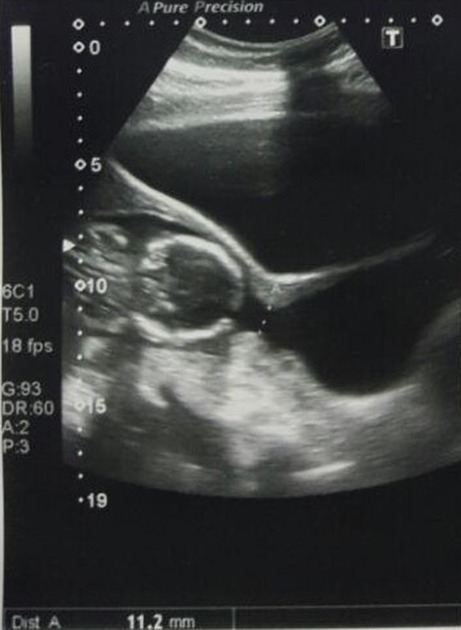
Transvaginal scanning is required. The opening of the cervical os at rest or in response to fundal pressure is considered an early feature of cervical incompetence 18. Other findings include:
-
bulging of the fetal membranes into a widened internal os (considered the most reliable sign 9)
the appearance of this can worsen from a T-shape to a Y-shape to a V-shape and finally to a U-shape (see: cervical incompetence mnemonic)
if there is complete bulging, it can give an hourglass-type appearance
in severe cases, there may be fetal parts or umbilical cord that extend through the os
The cervical length (CL) is obtained by measuring the endocervical canal from the internal cervical os to the external cervical os.
The normal cervix should be at least 30 mm in length. Cervical incompetence is variably defined, however, a cervical length of <25 mm at or before 24 weeks is often used.
In borderline cases, fundal pressure may be used to confirm the diagnosis.
Sonographic determination of the residual closed length of the cervix may be measured if there is:
known complicating preterm premature rupture of membranes
known hourglass type membranes
active vaginal bleeding
Treatment and prognosis
Cervical shortening is a prognostic indicator for the risk of preterm labor progressing into preterm delivery.
The risk of preterm delivery is inversely proportional to cervical length ref:
18% for <25 mm
25% for <20 mm
50% for <15 mm
The presence of cervical funneling is also an important finding. Greater than 50% funneling before 25 weeks is associated with an 80% risk of preterm delivery.
Management options can be controversial, with conflicting results, particularly regarding the efficacy of a cerclage placement as treatment. Bed-rest, tocolysis, cerclage (tracheloplasty), transabdominal suture placement, and administration of steroids to accelerate fetal lung maturity are all treatment options to be considered. A meta-analysis suggests that cerclage is effective in reducing preterm births by 26% in singleton pregnancies.
If the cervical length is <30 mm (<3 cm), close interval follow up is recommended.




 Unable to process the form. Check for errors and try again.