

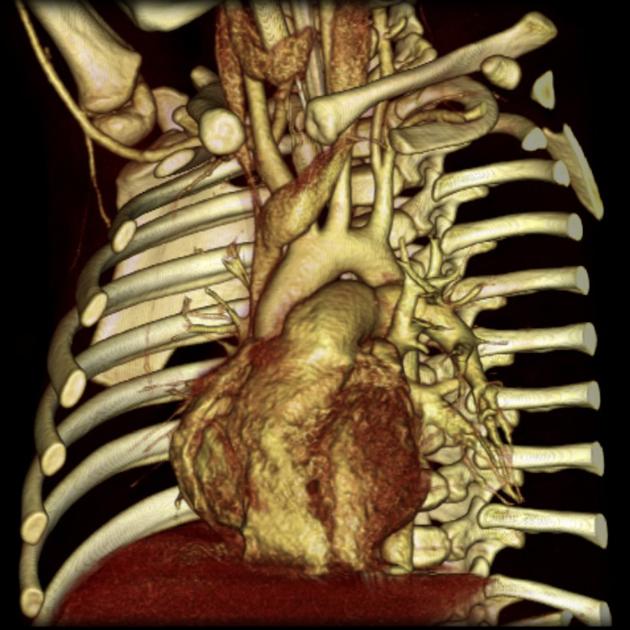
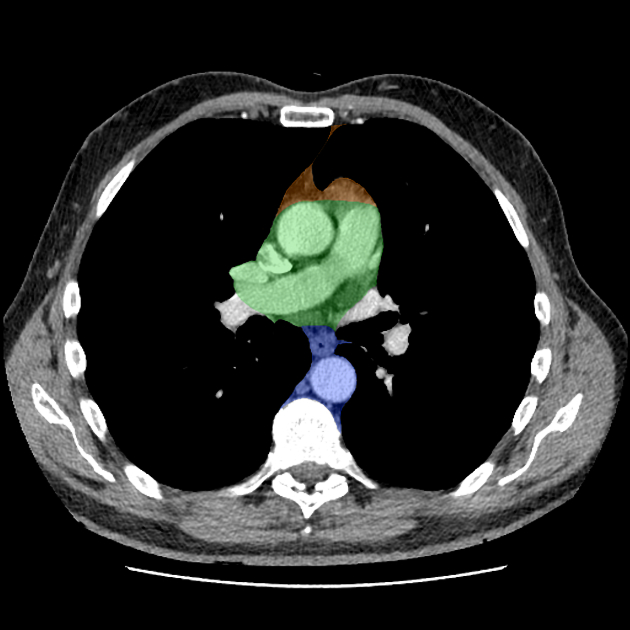
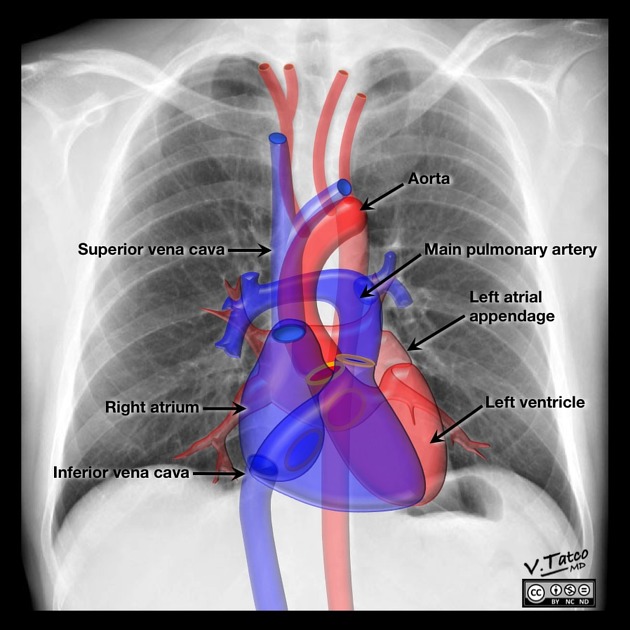
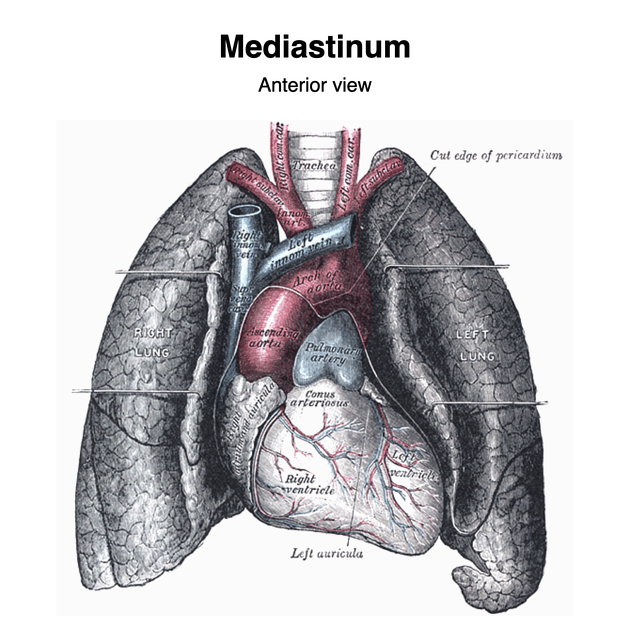
The mediastinum is a space in the thorax that contains a group of organs, vessels, nerves, lymphatics and their surrounding connective tissue. It lies in the midline of the chest between the pleura of each lung and extends anterior to posterior from the sternum to the vertebral column and superior to inferior from the superior thoracic aperture to the diaphragm.
Gross anatomy
The mediastinum contains all the thoracic viscera except the lungs: heart and great vessels, internal mammary vessels, proximal aspect of azygos venous system, esophagus, trachea, phrenic nerve, cardiac nerve, supra-aortic and para-aortic bodies, thoracic duct, thymus, and mediastinal lymph nodes.
Anatomical division
Division of the mediastinum is generally conceptualized as comprising three or four compartments, depending on the schema. For example, the mediastinum can be divided into parts based on their relationship to the fibrous pericardium:
superior mediastinum: above the upper level of the pericardium and transthoracic plane of Ludwig
-
inferior mediastinum: below the transthoracic plane of Ludwig
anterior mediastinum: anterior to the pericardium
middle mediastinum: within the pericardium
posterior mediastinum: posterior to the pericardium 8
Historically, there have been discrepant definitions of the mediastinal compartments between medical disciplines. For example, radiologists originally used arbitrary radiologic landmarks on lateral radiographs, while surgeons considered the mediastinum according to anatomic limits encountered intraoperatively (e.g. Shields classification). In response, there have been efforts to reconcile mediastinal classification systems for consistency 2.
The more modern ITMIG classification system, developed in by a multidisciplinary group including radiologists and thoracic surgeons, relies on CT-based anatomic divisions 3. It divides the mediastinum into three compartments with the following boundaries:
-
prevascular mediastinum:
superior: thoracic inlet
inferior: diaphragm
lateral: parietal mediastinal pleura
posterior: anterior aspect of the pericardium
-
visceral mediastinum:
superior: thoracic inlet
inferior: diaphragm
anterior: posterior boundary of the prevascular compartment
posterior: vertical line 1 cm posterior to the anterior margin of the thoracic vertebral bodies
-
paravertebral mediastinum:
superior: thoracic inlet
inferior: diaphragm
anterior: posterior boundary of the visceral compartment
posterior: a vertical line along the posterior margin of the chest wall at the lateral aspect of the transverse processes
Pathology
Broadly, pathology that affects the mediastinum can be divided into those that result in a focal mass, or those that result in diffuse disease involving the mediastinum.
The differential diagnosis of a mediastinal mass is highly dependent on its location within the mediastinum, as this may reveal the structure of origin. Thus, there is a specific differential diagnosis for each compartment:
In cases where localization is difficult due involvement of multiple compartments, the ITMIG recommends a "center method" technique by which the central point on the axial slice where the lesion appears largest is used for localization 3. Alternatively, a "structure displacement" technique whereby displacement of organs from adjacent compartments may be used to localize the lesion 4.
Diffuse mediastinal disease can be separated into groups depending on whether the mediastinal disease is smooth or lobulated:
-
smooth
-
lobulated
Finally, air tracking into the potential mediastinal spaces (pneumomediastinum) may occur when there is rupture of an air-containing structure, penetrating injury, or may be iatrogenic.





 Unable to process the form. Check for errors and try again.